Data Center Evaporative Cooling
How much water evaporative cooling actually uses, what's really behind the claim that data centers raise nearby temperatures by up to 16 degrees, and what the evidence does and doesn't say about a link to extreme weather and flooding. Plainly, with sources.
Last updated September 29, 2026

Terms
- Evaporative cooling
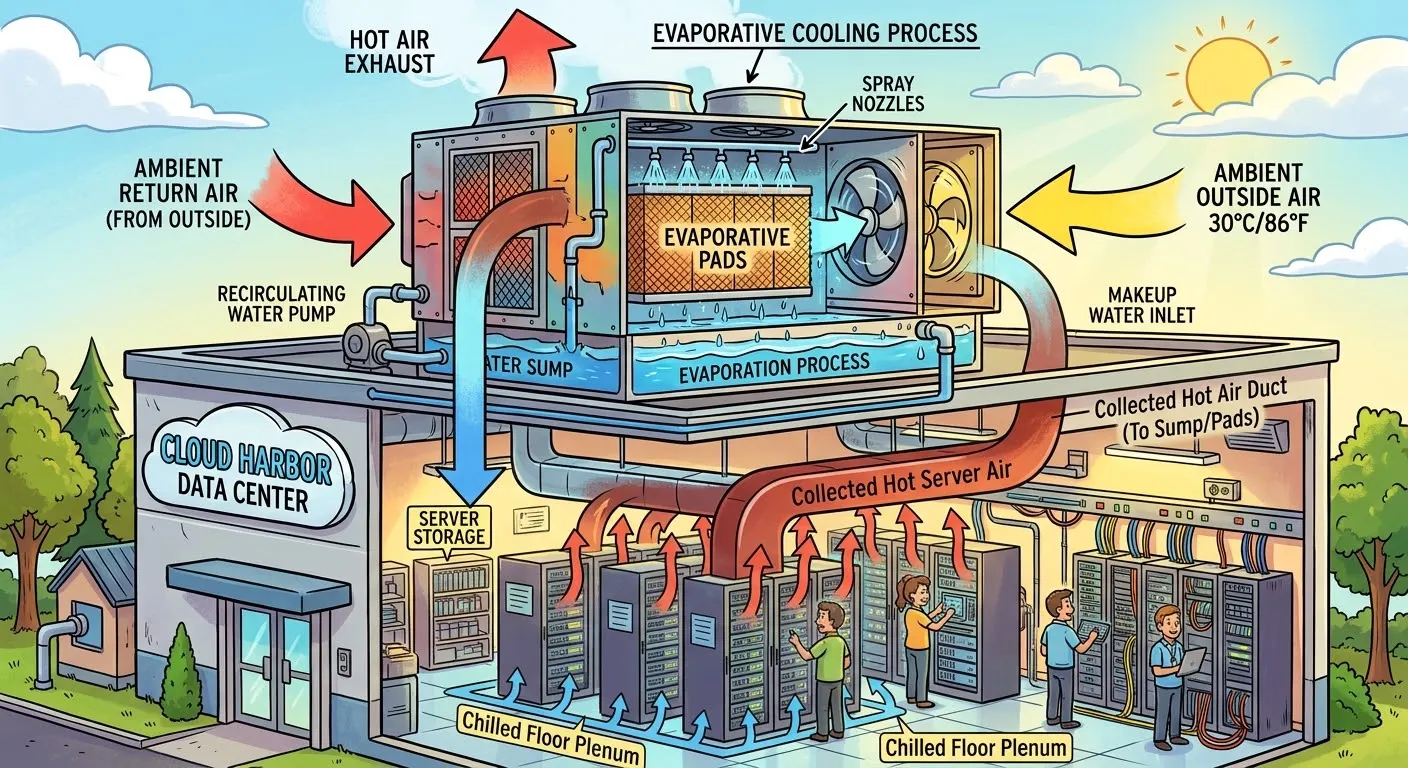
- A cooling method that runs warm water over air or through cooling towers so some of it evaporates, carrying heat away as water vapor. It's cheaper to run than mechanical air conditioning but consumes the water it evaporates.
- Land surface temperature
- The temperature of the ground or a rooftop itself, as measured by satellite. It's routinely much higher than air temperature — a parking lot can read 40°F hotter than the air above it on a sunny day — and the two are easy to conflate in news coverage.
- Heat island effect
- The well-established phenomenon where developed land (pavement, roofs, buildings) runs warmer than surrounding vegetation. Any large facility contributes to it; the open question is how much of a data center's contribution is its operational heat versus simply being a large building where there used to be open land.
The water use is real, and it's large
Evaporative cooling towers use large volumes of water to absorb and release a data center's heat into the air. An efficiently run evaporative system uses roughly 1,000 liters of water per megawatt-hour of IT load. In practice, that adds up fast: enterprise data centers commonly use 300,000 to 500,000 gallons of water a day, and large hyperscale facilities in hot climates can use 1 million to 5 million gallons a day. Google reports its facilities average 550,000 gallons daily company-wide; its largest single data center, in Council Bluffs, Iowa, withdrew an average of 3.9 million gallons and consumed 2.8 million gallons a day. We cover the water-rights and community-conflict side of this in more depth on our main data center water page.
By the numbers
- Typical enterprise data center water use, per day
- 300K–500K gal
- Water per megawatt-hour of IT load
- ~1,000 L
- Extreme-case land surface temperature increase (unreviewed study)
- 16.4°F
Data Center Knowledge; EESI; the non-peer-reviewed "Data Heat Island Effect" preprint, as reported by CNN.
Does it really raise the temperature by 16 degrees?
The 16-degree figure is real, but it needs three caveats the original coverage often dropped. A March 2026 study — nine researchers affiliated with Cambridge, Nanyang Technological University, and others, using 20 years of NASA satellite data — found ambient surface temperatures rose an average of 3.6°F after a data center began operating nearby, with increases as high as 16.4°F in places like Mexico's Bajío region and Aragón, Spain. That's the source of the "16 degrees" claim. It has not yet been peer-reviewed, it measures data center heat exhaust broadly rather than evaporative cooling specifically, and — this is the big one — it measures land surface temperature by satellite, not the air temperature people actually experience.
The claim
- Average +3.6°F, up to +16.4°F, in land surface temperature near data centers.
- Effects detected more than 6 miles out in some locations.
- Framed by the study and much of its coverage as data centers' operational heat warming their surroundings.
The pushback
- A published critique argues the effect is mostly land-use change: buildings and pavement simply run hotter than the grass or desert they replaced, regardless of what's inside them.
- Basic thermodynamic math suggests even a large 100-megawatt facility's actual waste heat could only account for roughly 1–3% of the measured increase.
- A separate, peer-reviewed study (Arizona State University, air-cooled systems specifically) found a real but much smaller effect: 1.3–4°F higher air temperature about a third of a mile downwind.
Both things can be true at once: data centers plausibly do create a real, measurable local warming effect, similar to any other large industrial building — and the specific "16 degrees" framing conflates land-surface heat with air temperature, and general data center heat exhaust with evaporative cooling specifically, in ways the original study didn't set out to untangle.
What about the moisture, and extreme weather?
There's a real, narrow, decades-old body of research on this — just not for the mechanism usually implied. Large industrial evaporative cooling towers (studied mostly at power plants, not data centers specifically) can measurably increase local fog: one Illinois State Water Survey analysis found roughly 300 extra hours of fog a year within about 3 kilometers downwind of a cooling tower in the direction of the prevailing wind, and can modestly raise local humidity and cloudiness in that same small radius. That's a real, if narrow, effect.
We found no credible evidence that this scales up into "increasing extreme weather events and flooding" more broadly — that would require a cooling tower's water vapor plume to meaningfully alter regional storm systems, which isn't how atmospheric moisture works at that scale. The well-established relationship between moisture and extreme weather actually runs the other direction: a warming atmosphere holds roughly 4% more moisture for every degree Fahrenheit of warming, which is what's driving heavier rainfall and flood risk broadly, as a matter of basic physics tied to global climate change, not local cooling-tower plumes. If anything, that trend is now recognized as a risk to data centers, not from them: flooding, wildfire, and extreme heat are increasingly cited as physical threats to data center siting and uptime.
Plainly, there has not been research to measure if data center evaporative cooling causes a noticable impact on climate change.
Nonpartisan, plainly
Two of the three claims in this fight hold up, with caveats; one doesn't hold up as stated. Data center evaporative cooling really does use hundreds of thousands to millions of gallons of water a day — that's not contested. A real local warming effect near data centers is plausible and partly documented, but the specific "16 degrees" figure comes from a non-peer-reviewed study measuring land surface heat, not air temperature, and a published critique argues most of that effect is ordinary land-use change rather than the data center's operational heat — both the original framing and the pushback deserve to be read, not just one side. The claim that evaporative cooling's water vapor increases regional extreme weather and flooding isn't supported by what we could find; the real, narrow phenomenon in the literature is localized fog near large cooling towers, and the broader, well-documented relationship between moisture and flooding runs from climate change to data centers as a risk, not from data centers outward as a cause. We're not defending or attacking evaporative cooling as a technology choice here — just trying to get the physical claims right.
Talking points
These are the questions we think you should ask those who are running for office and will represent you.
- Should data centers using evaporative cooling be required to publicly report their daily water withdrawals, the way some already voluntarily do?
- Should local zoning require an independent air-temperature study, not just a land-surface satellite study, before approving a new data center near housing?
- In water-stressed regions, should data centers be required to use air-cooled or closed-loop systems instead of evaporative cooling, even at higher energy cost?
Read more
- Data Center Frontier: Tech Explainer: Data Center Cooling — Air, Evaporative, Liquid, and Hybrid Approachesdatacenterfrontier.com
How evaporative cooling works, referenced above.
- Data Center Knowledge: Why Data Centers Still Rely on Evaporative Coolingdatacenterknowledge.com
Industry water-use figures cited above.
- EESI: Data Centers and Water Consumptioneesi.org
The daily water-use figures by facility size, above.
- arXiv preprint: The Data Heat Island Effectcnn.com
The non-peer-reviewed satellite study behind the “16 degrees” figure, as reported by CNN, above.
- Andy Masley: Data centers' heat exhaust is not raising the land temperature that muchblog.andymasley.com
The methodological critique — land-use change, the 1–3% thermodynamic estimate, and the land-vs-air-temperature distinction — above.
- Facilities Dive: Data centers raise temperatures up to 4 degrees in nearby neighborhoods, ASU study findsfacilitiesdive.com
The peer-reviewed, air-cooling-specific thermal plume study, above.
- Illinois State Water Survey: Effect of Cooling Tower Effluents on Atmospheric Conditionsisws.illinois.edu
The real, narrow cooling-tower fog research (~300 extra fog-hours/year within 3 km), above.
- Quartz: AI data centers face threats from flooding, wildfires, extreme heatqz.com
Flooding and extreme weather as a risk TO data centers, the opposite causal direction from the claim addressed above.