Data centers and the Clean Air Act
A federal law written to keep new pollution sources from operating without review, and what happened when one of the world's largest data centers tested how well that law actually gets enforced — in South Memphis, Tennessee.
Last updated September 22, 2026

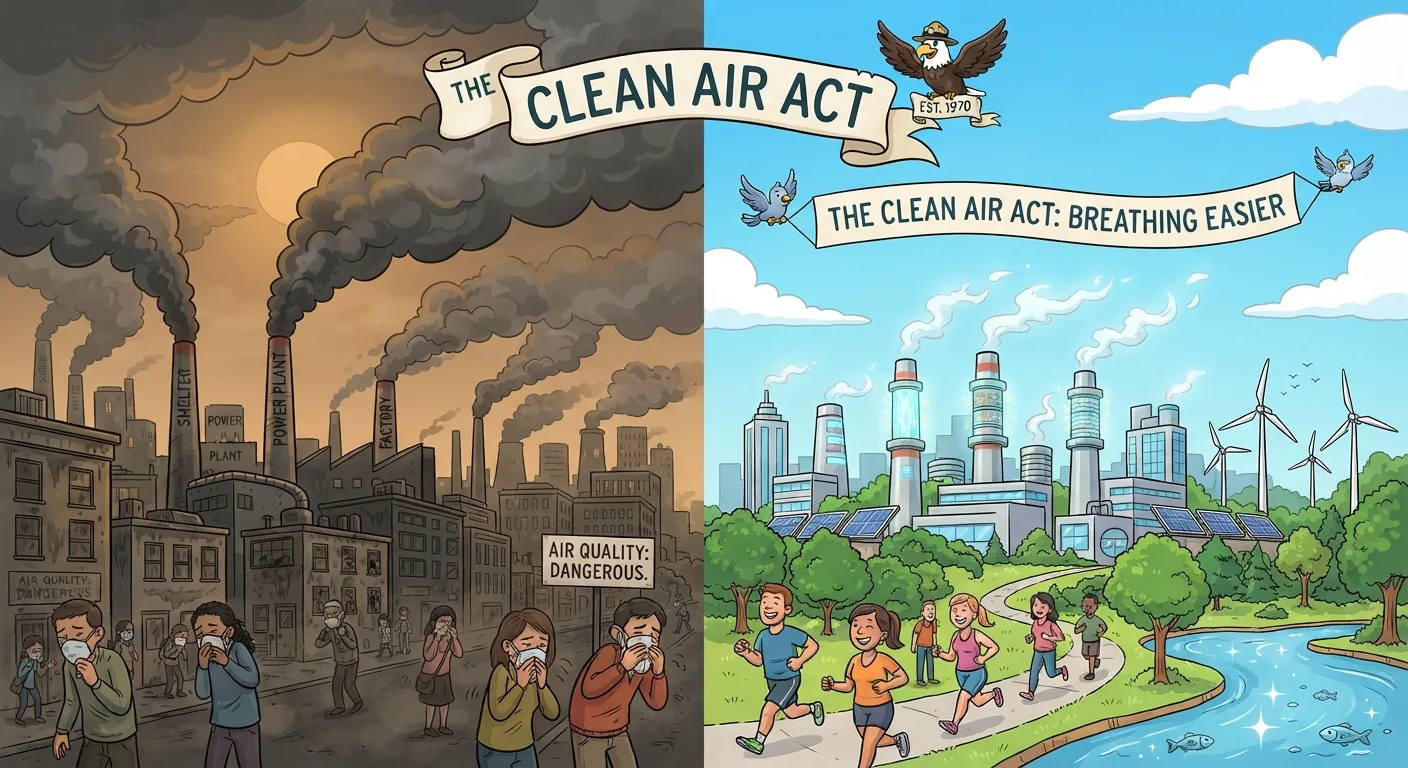
The law this is testing
The Clean Air Act requires most new stationary sources of air pollution — power plants, factories, and similarly large fixed equipment — to get a permit before they start operating, not after. Depending on how much a facility would emit, it's reviewed either as a "minor source" (a faster, lighter process) or a "major source" (stricter limits, more public process, and often required pollution controls). In Tennessee, that review is delegated to local agencies — in Shelby County, the Shelby County Health Department — operating under a state plan the EPA has approved.
One thing the law doesn't tightly regulate: genuinely temporary, portable engines, like the generators a construction site runs for a few weeks. That "nonroad engine" exemption is the center of this dispute — whether large gas turbines, run continuously for a year or more at a fixed site, are the kind of equipment that exemption was written for.
What happened at Colossus
- Turbines xAI first described, mid-2024
- ~18
- Turbines found running, March 2025
- 35
- Turbines the July 2025 permit covers
- 15
- Board vote dismissing the appeal
- 6–1
E&E News/POLITICO; Southern Environmental Law Center; Action News 5.
xAI's Colossus supercomputer — at the time, the company called it the world's largest — came online in a former electronics plant in South Memphis in September 2024, built around roughly 100,000 Nvidia GPUs and, within months, plans to double that. To power it before a permanent grid connection was ready, xAI brought in gas turbines it described as temporary. In August 2024, the Shelby County Health Department told xAI it didn't need a permit for them, treating the turbines as exempt "nonroad" equipment.
By March 2025, aerial photographs showed 35 turbines on site — roughly double what had been publicly described — and thermal imaging the following month found 33 of them actively generating heat and electricity. xAI applied that January for a permanent air permit, but only for 15 turbines. The Shelby County Health Department approved that permit on July 2, 2025, after a public hearing, with xAI committing to add pollution-control equipment it said would cut turbine emissions substantially.
Two weeks later, the Southern Environmental Law Center, on behalf of the NAACP and the local group Young, Gifted & Green, appealed that permit to the Memphis and Shelby County Air Pollution Control Board. Their argument went further than "you under-permitted this": they argued turbines this large, producing hundreds of megawatts continuously, don't qualify for the nonroad exemption at all — meaning even the 15 permitted turbines, not just the extra 20, should have gone through full Clean Air Act review as a major source from the start. They asked the board to void the permit entirely. On December 15, 2025, after a seven-hour hearing, the board voted 6–1 to dismiss the appeal as moot, leaving xAI's permit in place; petitioners said they were weighing further legal options.
What the turbines put in the air
Gas turbines emit nitrogen oxides (NOx) — a smog-forming pollutant that also reacts in the atmosphere to form fine particulate matter — along with hazardous air pollutants like formaldehyde. Using manufacturer-supplied emissions data, SELC and allied groups estimate the Colossus turbines emit somewhere between 1,200 and 2,000 tons of NOx per year, which would make the facility the single largest industrial source of NOx in Memphis. Without pollution controls, the turbines' exhaust reportedly ran 9 to 25 parts per million NOx; xAI has said its added controls would bring that down to about 2 ppm. For what NOx and formaldehyde actually do to the human body once inhaled, see our page on the health effects of nitrogen oxides and formaldehyde.
Two studies, two different answers
Independent researchers have looked at the same basic question — did measurable air quality actually change after Colossus started running — and reached different conclusions, which is worth presenting honestly rather than picking the more dramatic number.
University of Tennessee, for TIME
Using NASA and European Space Agency satellite data, this analysis compared nitrogen dioxide levels before and after June 2024. It found peak (not average) NO2 concentrations rose 79% in the area immediately around the site and 9% in nearby Boxtown; the average across the whole period rose about 3%. The researchers focused on peaks because brief high-concentration spikes carry more health risk than a small change in the average — and noted some of that pollution may also come from a nearby TVA power plant that separately supplies xAI about 150 MW.
University of Memphis
Using EPA-recommended dispersion modeling on xAI's self-reported emissions, plus satellite data and a two-day independent ground-monitoring campaign, these researchers found the turbines contributed "minimally" to ambient pollution — roughly a 1% increase in fine particulates, with NOx, sulfur dioxide, and carbon monoxide staying well under national standards. They also flagged a real limitation of their own study: their monitoring wasn't sensitive enough to detect trace levels of benzene, toluene, or other hazardous air pollutants tied to serious health effects.
The neighborhood this is happening in
Colossus sits a few miles from Boxtown, a majority-Black South Memphis community with a median household income around $37,000, already bordered by refineries, pipelines, and Superfund sites from decades of prior industrial development. Shelby County leads Tennessee in asthma emergency-room visits, and the area's cancer risk is well above the national average — a burden that long predates Colossus. Residents describe the turbines as one more source layered on top of that existing load. Alexis Humphreys, holding up her inhaler at a public hearing, put it plainly: "I can't breathe at home, it smells like gas." Longtime resident Willie Joe Stafford, 81, has said the mucus he now regularly coughs up started after the turbines arrived. State Rep. Justin J. Pearson's group, Memphis Community Against Pollution, raised $250,000 for its own independent air testing, saying it doesn't trust official monitoring to have captured everything, including ozone.
On the specific, serious question of whether the turbines' emissions have caused a death: we looked for confirmed reporting of that and didn't find it. What we did find, reported by E&E News, is a resident, KeShaun Pearson, who has publicly attributed his grandmothers' cancer deaths in their 60s to the area's long-term air pollution burden — his own words, about longstanding industrial pollution generally, not a medical or regulatory finding tied specifically to Colossus's turbines. We didn't want to either repeat an unverified claim as fact or leave out what residents are actually saying, so here it is with that distinction made clearly.
Nonpartisan, plainly
We take the position that we should all be able to breath freely without pain.
However, we don't take a position on whether xAI's permit should have been granted, whether the Air Pollution Control Board's ruling was correct, or what the right regulatory response to fast-moving data center construction should be — these are live legal and policy disputes with real arguments on more than one side, including a genuine scientific disagreement between two independent research teams on how much the air actually changed. What's documented, plainly: how many turbines ran without a permit, for how long, what the permit that followed covers, and how the legal challenge to it was resolved.
See something wrong at a data center near you?
Noise, unpermitted construction, water or air complaints, or anything else worth documenting — Erin Brockovich's team runs a crowdsourced tracker where residents can report data center issues directly.
Report a data center issue ↗Talking points
These are the questions we think you should ask those who are running for office and will represent you. We don't give our opinion on the answer, but we DO think you should be talking about them.
- Should companies be allowed to operate emissions-generating equipment while a permit application is still pending?
- Should local air-quality boards have independent authority to shut down unpermitted equipment immediately, without a lengthy appeal process?
- Should there be a public, real-time registry of every unpermitted-operation or violation notice issued to a facility?
Read more
- E&E News (POLITICO): '35 gas turbines, no air pollution permits'eenews.net
The most detailed timeline of what xAI disclosed, when, and what investigators found on the ground.
- Southern Environmental Law Center: xAI permit appealselc.org
The legal filing on behalf of the NAACP and Young, Gifted & Green, and its specific Clean Air Act arguments.
- Fox13 Memphis: Shelby County permits 15 turbinesfox13memphis.com
Local coverage of the July 2025 permit approval and the independent air-testing effort that followed.
- Action News 5: Air Pollution Control Board dismisses the appealactionnews5.com
The December 2025 board vote and where the case stands now.
- TIME: Inside Memphis' Battle Against Elon Musk's xAI Data Centertime.com
Commissioned the University of Tennessee satellite analysis of nitrogen dioxide levels cited above.
- The Conversation: Air quality analysis reveals minimal changestheconversation.com
The University of Memphis researchers' competing dispersion-modeling analysis, for contrast.
- Brockovich AI Data Center Reportingbrockovichdatacenter.com
An environmental advocate's crowdsourced map and community reports, including on the Colossus site.