Price gouging
What the law actually restricts, what just got enforced in Los Angeles, and why economists and the public disagree about the whole idea almost completely.
Last updated September 22, 2026

Terms
- Price gouging
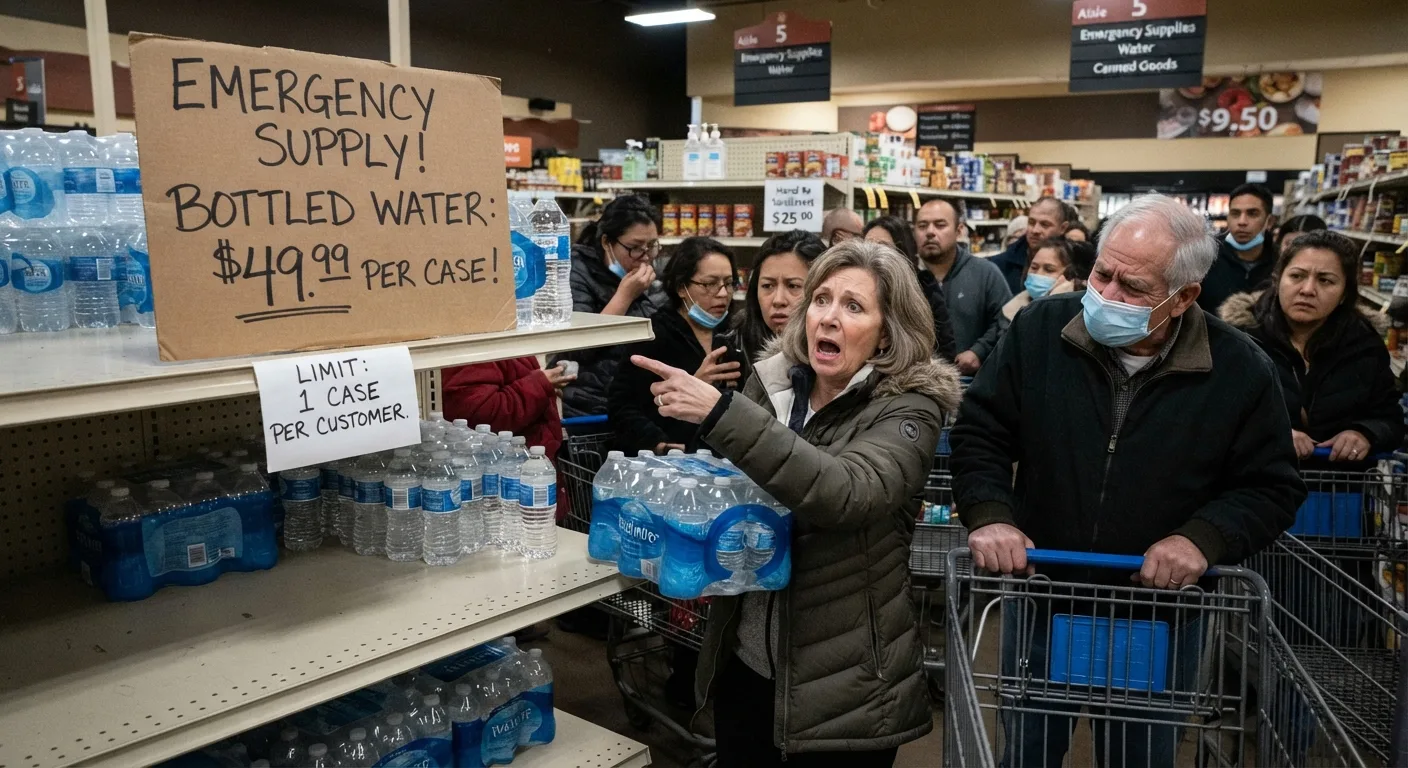
- A single seller charging an unconscionably high price during a declared emergency — regulated, where it's regulated at all, by state law.
- Price fixing
- Competitors coordinating with each other on price, directly or through shared data/software — illegal everywhere in the U.S. under federal antitrust law, emergency or not.
Both get called "price gouging" in headlines and conversation. They're legally distinct, and two of the biggest recent stories below are actually the second kind.
How price gouging law actually works
- Federal price gouging statute
- None
- States (+ D.C.) with a price gouging law
- ~37
- California's threshold above pre-emergency price
- 10%
- Some states set the line instead at
- 25%
FindLaw; state statutes.
There is no general federal law against price gouging — it's entirely a state-by-state patchwork, and roughly a dozen states have no statute at all. Where a law exists, it almost always only switches on once a governor or local official declares a state of emergency, and it typically covers necessities: food, water, gas, generators, lodging, and often rent. California caps increases at 10% above the pre-emergency price on covered goods and services; other states draw the line at 15% or 25%, and Florida instead bars any increase that "grossly exceeds" the 30-day average before the emergency. Enforcement is mostly up to state attorneys general, who can seek fines, restitution, and injunctions; a few states also let consumers sue directly.
What just happened in Los Angeles
When Governor Newsom declared a state of emergency after the January 2025 Palisades and Eaton fires, it automatically activated California's price gouging law across the counties covered — including on rental housing, which isn't usually top of mind when people picture "price gouging." Within weeks, the state DOJ had sent more than 500 warning letters to hotels and landlords and filed charges against a real estate agent accused of raising a fire survivor's rent quote by 38% over what had been advertised. A later tenant-advocate report identified roughly 5,000 rent listings in the area that appeared to violate the 10% cap. Violators face fines up to $10,000 and up to a year in jail per violation.
The other kind: coordinated price-fixing
Two of the most-covered "price gouging" stories of the past two years are actually federal antitrust cases — about competitors coordinating, not one seller overcharging during a disaster.
Eggs: as avian flu cut into the U.S. laying-hen flock, egg prices hit a record $6.23 a dozen in March 2025 — a bigger jump than the supply loss alone would predict, while major producers posted record profits over the same stretch. The DOJ and a bipartisan group of state attorneys general opened an investigation into whether large producers coordinated to keep prices elevated; a 2026 settlement required the companies to pay $3.3 million and donate more than 7 million eggs to food banks, without admitting wrongdoing.
Rent-setting software: the DOJ and several states sued RealPage, alleging its rent-pricing software let competing landlords effectively coordinate prices by feeding each other's nonpublic pricing and lease data into a shared algorithm. A November 2025 settlement bars RealPage from training its pricing tool on other landlords' nonpublic data; combined with related settlements, the total recovery across these cases now tops $247 million. New York separately passed a law banning residential landlords from using rent-setting algorithms at all.
Economists hate these laws; the public loves them
This is one of the widest expert/public opinion gaps in economic policy, and it's been measured directly, more than once.
What economists say
In an IGM Forum survey of top economists, only 3% agreed with a federal Price Gouging Prevention Act proposed by Sen. Elizabeth Warren; 84% disagreed. An earlier IGM survey on a Connecticut anti-gouging bill found 51% of economists disagreed and just 8% agreed — a gap that widened to 77%-to-7% once weighted by how confident each economist was. The standard argument, as Harvard's Eric Maskin put it: "At a time of shortage, high prices can serve to stimulate an increase in supply" — and price caps can instead produce shortages, hoarding, and empty shelves.
What the public says
Separate research (Klofstad & Uscinski, 2023) found overwhelming public support for anti-price-gouging laws that barely budges even after people are shown the standard economic argument against them. The public's reasoning tends to run on fairness — exploiting someone's emergency for profit — more than on how markets allocate scarce goods.
Nonpartisan, plainly
We don't take a position on whether price gouging laws help or hurt, whether the threshold should be 10% or 25%, or whether Congress should pass a federal version — that's a real disagreement between economists and the public that this page isn't going to settle. These are the laws as written, the cases as enforced, and the survey numbers as measured, plainly.
Talking points
These are the questions we think you should ask those who are running for office and will represent you. We don't give our opinion on the answer, but we DO think you should be talking about them.
- Should Congress pass a federal price gouging law, given that today's protection comes almost entirely from a patchwork of state laws?
- Should a price gouging law apply automatically during any federally declared disaster, or should states keep setting their own thresholds?
- Should companies engaged in coordinated price-fixing face criminal penalties, not just civil fines?
- Given economists warn price caps can worsen shortages, should the law prioritize consumer protection or supply availability during an emergency?
Read more
- FindLaw: Price Gouging Laws by Statefindlaw.com
A state-by-state rundown of thresholds, triggers, and penalties.
- California DOJ: Rental Bidding Wars During LA Wildfires Prohibitedoag.ca.gov
Attorney General Bonta's office on enforcing California's price gouging statute after the January 2025 fires.
- CNBC: Big egg producers settle price inflation probe with DOJcnbc.com
The 2026 settlement in the DOJ's egg-producer price-coordination investigation.
- Mintz: RealPage Reaches Settlement Agreement with the Department of Justicemintz.com
The November 2025 algorithmic rent-pricing antitrust settlement.
- ProMarket: Economists Don't Think Congress Should Make Price Gouging Illegalpromarket.org
The IGM Forum survey behind the economist figures below.