How nitrogen oxides and formaldehyde affect the body
Two of the pollutants gas turbines put in the air, and what federal health agencies have actually found about what each one does once it's inhaled.
Last updated September 29, 2026

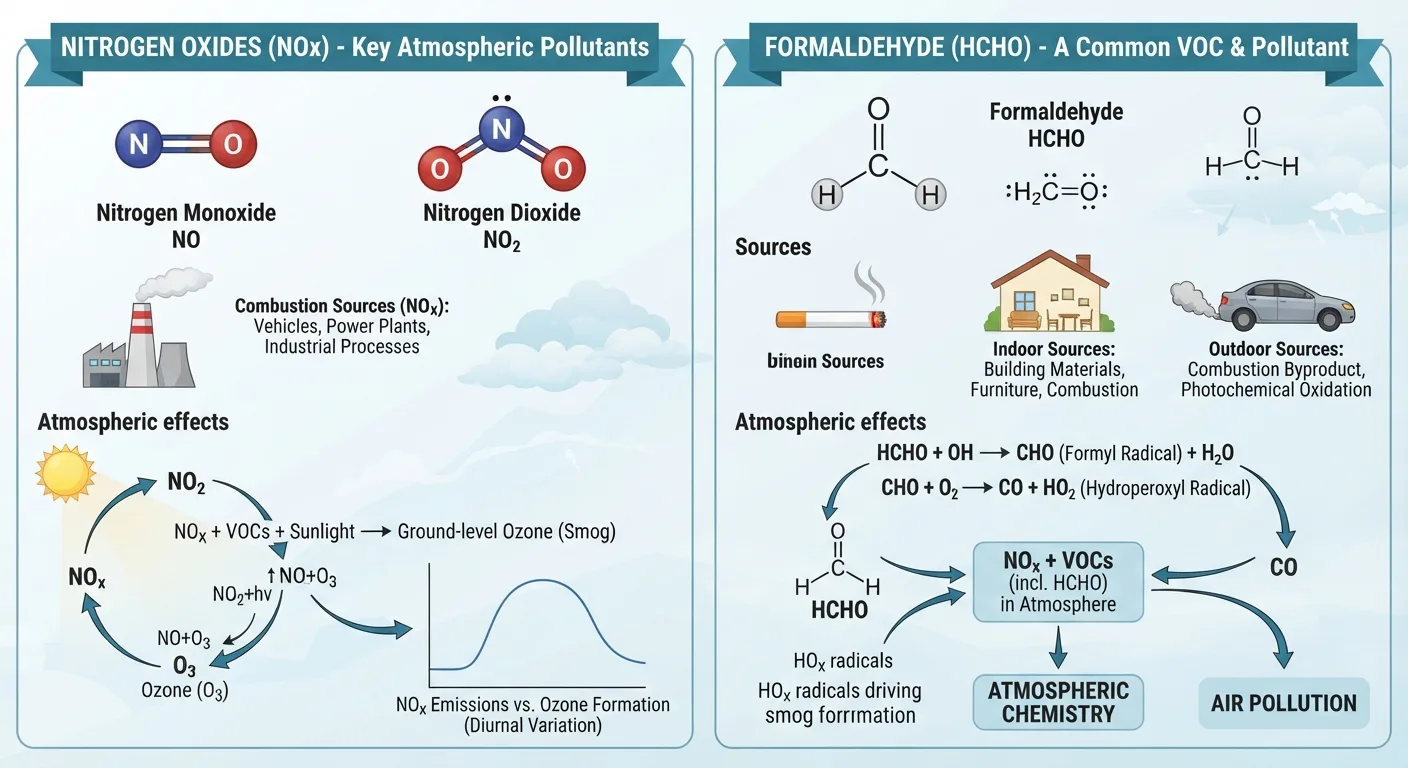
Two different pollutants, two different problems
Gas turbines — like the ones running at data centers such as xAI's Colossus in Memphis — burn natural gas at high temperature and pressure. That combustion doesn't just produce useful heat and electricity; it also produces nitrogen oxides (NOx) as a near-unavoidable byproduct of burning anything in air, and, when combustion is incomplete, trace formaldehyde and other aldehydes. They're regulated separately because they act on the body in different ways: NOx is mainly an airway irritant with a regulated ambient air-quality standard, while formaldehyde is a stronger irritant that's also classified as a known human carcinogen at high enough cumulative exposure.
- NO₂ 1-hour air quality standard
- 100 ppb
- Formaldehyde odor threshold
- ~0.5–1 ppm
- Sensitized reaction can start at
- 0.3 ppm
- IARC formaldehyde classification
- Group 1
EPA; ATSDR/CDC; IARC.
Nitrogen oxides (NOx)
"NOx" covers nitric oxide (NO) and nitrogen dioxide (NO2) — NO oxidizes into NO2 in the air within hours. NO2 is the one with a federal health standard: the EPA's primary National Ambient Air Quality Standard sets a limit of 100 parts per billion averaged over any one hour, specifically because of what happens above that level.
NO2 is a direct airway irritant — EPA describes the mechanism as oxidant injury to lung tissue. Short-term exposure (minutes to a day) can aggravate asthma, causing coughing, wheezing, and difficulty breathing severe enough to drive emergency-room visits. Longer-term exposure is linked to the development of asthma, not just flare-ups of it: researchers have observed roughly a 5–10% increase in childhood asthma incidence for every 10 micrograms per cubic meter rise in long-term NO2 exposure. People with existing asthma, children, and the elderly are consistently identified as the groups at greatest risk.
NOx's health effects don't stop at NO2 itself. Once released, it reacts with other compounds in the air, sunlight, and heat to form both ground-level ozone (the main ingredient in smog) and fine particulate matter — both independently regulated, both independently linked to respiratory and cardiovascular harm. That's part of why NOx emissions get measured in tons per year at facilities like Colossus: a large enough source can shift air quality for pollutants it doesn't even emit directly.
Formaldehyde
Formaldehyde is a colorless gas with a sharp smell, produced whenever combustion is incomplete — a normal byproduct of burning natural gas, not a sign of equipment malfunction, though better combustion control and catalytic exhaust treatment reduce how much escapes. The International Agency for Research on Cancer classifies it as a Group 1 carcinogen — "carcinogenic to humans" — based on evidence linking sustained exposure to nasopharyngeal cancer and leukemia.
Its acute effects scale with concentration:
Formaldehyde is also what ATSDR calls a "potent sensitizer": once someone's immune system reacts to it, that person can go on to have asthma-like or skin (dermatitis) reactions at concentrations that wouldn't bother someone who's never been sensitized. ATSDR's toxicological review also documents nervous-system symptoms — headache, mood changes, insomnia, trouble concentrating — associated with repeated exposure, on top of the respiratory and cancer risks.
Why this matters for how turbines are permitted
Both of these are exactly why the Clean Air Act treats large combustion equipment as something to review before it starts running, not after: the health effects scale with both concentration and duration, and the tools that cut them — combustion tuning, selective catalytic reduction, oxidation catalysts — are things regulators can require as a condition of a permit, but not retroactively undo months of uncontrolled operation. At xAI's Colossus data center in Memphis, the turbines reportedly ran at 9 to 25 parts per million NOx uncontrolled, with the added pollution controls xAI committed to bringing that down to roughly 2 ppm — the gap between those numbers is, in practical terms, the gap this page describes.
Nonpartisan, plainly
We don't take a position on what emissions limits are appropriate, what pollution-control technology should be required, or how to weigh the economic case for a project against its air-quality cost — those are policy judgments with legitimate arguments on more than one side. What isn't a matter of opinion is what federal health and toxicology agencies have found these two pollutants do to the human body. These are their findings, plainly.
See something wrong at a data center near you?
Noise, unpermitted construction, water or air complaints, or anything else worth documenting — Erin Brockovich's team runs a crowdsourced tracker where residents can report data center issues directly.
Report a data center issue ↗Talking points
These are the questions we think you should ask those who are running for office and will represent you. We don't give our opinion on the answer, but we DO think you should be talking about them.
- Should turbine and power-generation permits require independent, third-party air-quality monitoring rather than operator-reported data?
- Should a facility be required to directly notify nearby residents when a permit allows pollutant levels near a health-based threshold?
Read more
- EPA: Basic Information about NO2epa.gov
EPA's own summary of how nitrogen dioxide harms the respiratory system, and its link to ozone and particulate matter.
- American Lung Association: Nitrogen Dioxidelung.org
A plain-language rundown of NO2's health effects and who's most at risk.
- ATSDR/CDC: Formaldehyde Medical Management Guidelineswwwn.cdc.gov
The federal toxicology reference behind the exposure-level breakdown above.
- ATSDR: Toxicological Profile for Formaldehydeatsdr.cdc.gov
The full underlying federal toxicological review, for the chronic and cancer-risk findings.
- OSHA: Formaldehyde — Hazard Recognitionosha.gov
The occupational-exposure health summary, including its carcinogen classification.