Tariffs
Congress is the branch the Constitution puts in charge of tariffs. It handed much of that power away by statute, a president used one of those statutes further than the Supreme Court says the law allows, and the companies that overpaid are now getting refunded — while the consumers who actually covered the cost are not.
Last updated September 29, 2026

Terms
- Tariff
- A tax on an imported good, paid to U.S. Customs and Border Protection by the importer of record — the U.S. company bringing the goods in — not by the foreign government or the foreign company that made them.
- Importer of record (IOR)
- The company legally responsible for a shipment's customs paperwork and for paying any tariff owed on it. It is the only party CBP recognizes for a refund claim — a retail customer who paid a marked-up price at a store was never a party to that customs transaction.
- IEEPA
- The International Emergency Economic Powers Act of 1977, which lets a president regulate transactions to address a declared national emergency. Trump used it to impose most of his 2025 tariffs. The Supreme Court ruled in Feb. 2026 that it doesn't actually authorize tariffs at all.
- Section 232 / 301 / 122
- Three separate, older statutes that do explicitly let a president impose tariffs, each with its own limits: Section 232 (national-security investigation required), Section 301 (unfair-trade-practice investigation required), and Section 122 (balance-of-payments emergencies, capped at 15% and 150 days unless Congress extends it).
Whose job this actually is
Article I, Section 8 of the Constitution gives Congress — not the president — the power "to lay and collect taxes, duties, imposts and excises" and "to regulate commerce with foreign nations." Tariffs are duties on imports, so by the Constitution's own text, setting them is Congress's job. Chief Justice John Roberts, writing for the Supreme Court in Feb. 2026, put it plainly: the tariff power is "very clearly … a branch of the taxing power," and taxing power belongs to Congress.
Congress has delegated pieces of that power to the president over the decades, but every one of the statutes it used to do that — Section 232, Section 301, Section 122 — comes with guardrails: an investigation, a specific finding, or a rate cap and time limit. IEEPA, an emergency-powers law never written with tariffs specifically in mind, has none of those guardrails. That gap is exactly what the Supreme Court's 2026 ruling turned on.
What Trump actually imposed
The ruling, plainly
The case — consolidated as Learning Resources, Inc. v. Trump and V.O.S. Selections v. United States— was brought by small importers and a coalition of states. The majority (Roberts, Sotomayor, Kagan, Gorsuch, Barrett, and Jackson) held that IEEPA's language — letting a president "regulate" imports during an emergency — doesn't stretch to "tax" them, and that the sheer scale and duration of Trump's tariffs looked far more like the exercise of a taxing power Congress never delegated than like a targeted, temporary emergency measure. Thomas, Kavanaugh, and Alito dissented, arguing "regulate" was written broadly enough to include tariffs and that courts should defer to the president's judgment about a declared emergency.
The ruling did not touch Section 232 or Section 301 tariffs, which rest on different statutes with their own investigation requirements — those, including the steel, aluminum, and auto tariffs, remain in effect.
Who actually paid
- Estimated pass-through to consumer prices (range across Fed/academic studies)
- ~26–100%
- Tax Foundation-estimated 2025 tariff cost, average household
- ~$1,000
- Estimated combined 2025–2026 tariff cost, average household
- ~$1,700
- Typical lag before a tariff fully shows up in retail prices
- ~7 months
Tax Foundation; Federal Reserve Bank of New York staff research; see sources.
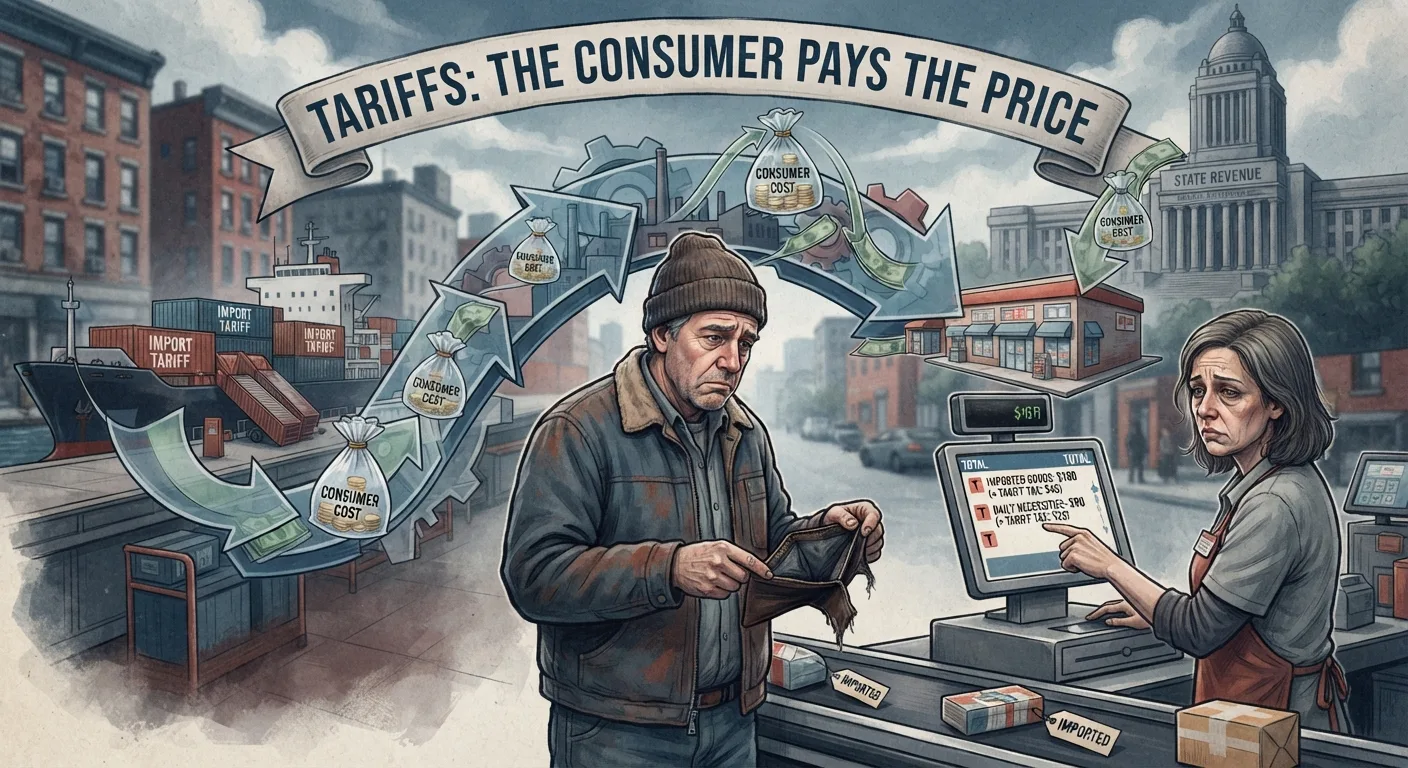
Tariffs are collected from the importer of record, but economists broadly agree importers pass most of that cost on — to retailers, and from retailers to shoppers. Exactly how much varies by study and by product category: Federal Reserve research has found pass-through rates as low as roughly a quarter of the tariff's cost in some early estimates, and as high as nearly the full cost (and in some durable-goods categories, effectively more than 100% once retailers also widen margins) in later ones as tariffs stayed in place longer. The honest summary is a wide range, not a single number — but every credible estimate has consumers absorbing a real majority of the cost, not foreign exporters.
Why you'll never see the refund
Once the Supreme Court struck down the IEEPA tariffs, CBP had to unwind roughly $85 billion in duties collected under them. Companies that had paid those duties as importers of record became eligible for refunds, filed through CBP's Post Summary Correction process and, since a CBP tool called CAPE went live on April 20, 2026, processed faster than before. A federal judge, Richard K. Eaton, ordered the refund process to proceed on March 4, 2026.
None of that refund is legally available to the person who bought the tariffed product at a store. The consumer never paid a tariff to CBP — they paid a retail price to a retailer, a price that happened to be higher because the retailer's own supplier had paid a tariff somewhere upstream. CBP's refund process only recognizes the importer of record as a party to that transaction. There is no legal mechanism for a shopper to file a claim, because a shopper was never a party to the customs entry in the first place.
That leaves the only realistic path for a consumer to see any of that money back as voluntary: a company getting a refund choosing to lower prices or issue credits. Estimates reported in 2026 put the share of refunded tariff money actually expected to reach consumers, through price cuts or rebates, at only around 15–20%. Companies cited several reasons for not passing more of it through: some said rising freight and energy costs — tied in part to the ongoing Iran war's effect on oil markets — had already eaten into the savings; others said tracking exactly how much tariff cost was baked into any single past sale, in order to refund it to the specific customer who paid it, was operationally close to impossible; and some simply treated the refund as recovered margin rather than money owed to anyone else. Economists at Goldman Sachs have separately observed that retail prices behave asymmetrically — companies raise them quickly when costs go up, but come down much more slowly, if at all, when costs fall. A small number of retailers, including Walmart and BJ's, said publicly they would pass some savings on to customers; most did not make that commitment.
Nonpartisan, plainly
Two separate things are true at once here, and neither is in real dispute. First: the Constitution puts the tariff power in Congress, Congress delegated part of it by statute with real limits attached, and the Supreme Court — on a mixed ideological lineup, not a predictable partisan split — found the administration had used a statute that doesn't actually contain that power. Second: the money already collected from that overreach is being returned to the companies that paid it, through a legal process that was never built to reach the households whose higher grocery, hardware, and retail bills covered most of the actual cost. That second fact isn't a loophole anyone hid; it's simply how a tariff refund has always worked, for any administration. It just means that whoever ultimately bears a tariff's cost and whoever gets reimbursed when a tariff turns out to be unlawful are, in practice, two different people.
Talking points
These are the questions we think you should ask those who are running for office and will represent you. We don't give our opinion on the answer, but we DO think you should be talking about them.
- Should Congress reclaim more of its constitutional tariff authority instead of delegating it to the executive branch through emergency statutes?
- Should companies receiving tariff refunds be required to pass a share back to the consumers who actually paid the higher price?
- Should there be a cap on how large an emergency tariff can be without a congressional vote?
Read more
- Supreme Court of the United States: Learning Resources, Inc. v. Trump (opinion)supremecourt.gov
The Feb. 20, 2026 ruling itself: IEEPA does not authorize tariffs.
- NPR: U.S. businesses are getting tariff refunds. Will customers get any money back?npr.org
Why the refund pipeline runs to importers, not shoppers.
- CNN: Companies got their tariff refunds. Where's your cut?cnn.com
Reporting on the roughly $85 billion in refunds and how little is expected to reach consumers.
- Federal Reserve Bank of New York: staff report on tariff pass-throughnewyorkfed.org
One of the underlying studies behind the consumer pass-through estimates below.
- Tax Foundation: tariff cost estimatestaxfoundation.org
The per-household cost estimates cited below, with methodology.
- U.S. Customs and Border Protection: Post Summary Correction / refund guidancecbp.gov
How importers of record — and only importers of record — claim a tariff refund.