Gas prices, the Iran war, and where the money's going
What's actually pushed pump and diesel prices up this year, how much of it traces to the war with Iran versus everything else, what oil companies have earned along the way, and how it's showing up in the price of things that have nothing to do with gasoline.
Last updated September 22, 2026

Terms
- Brent crude
- The international oil-price benchmark, priced off North Sea production — the number usually quoted in world oil news and the one referenced throughout this page.
- Strait of Hormuz
- The narrow shipping channel between Iran and Oman that more than a fifth of the world's seaborne oil trade passes through — the single chokepoint at the center of this story.
- Windfall profits tax
- A tax targeting profit judged to come from a price spike rather than a company's own investment or efficiency — the proposal discussed further down.
What's actually happened to prices
- U.S. average gas price, Sept. 17, 2026
- $4.43
- Same week, one year earlier
- ~$3.20
- U.S. average diesel price, Sept. 2026 (record)
- $6.45
- Diesel, year-over-year change
- +74%
AAA; Chase/CSMonitor reporting on national diesel data.
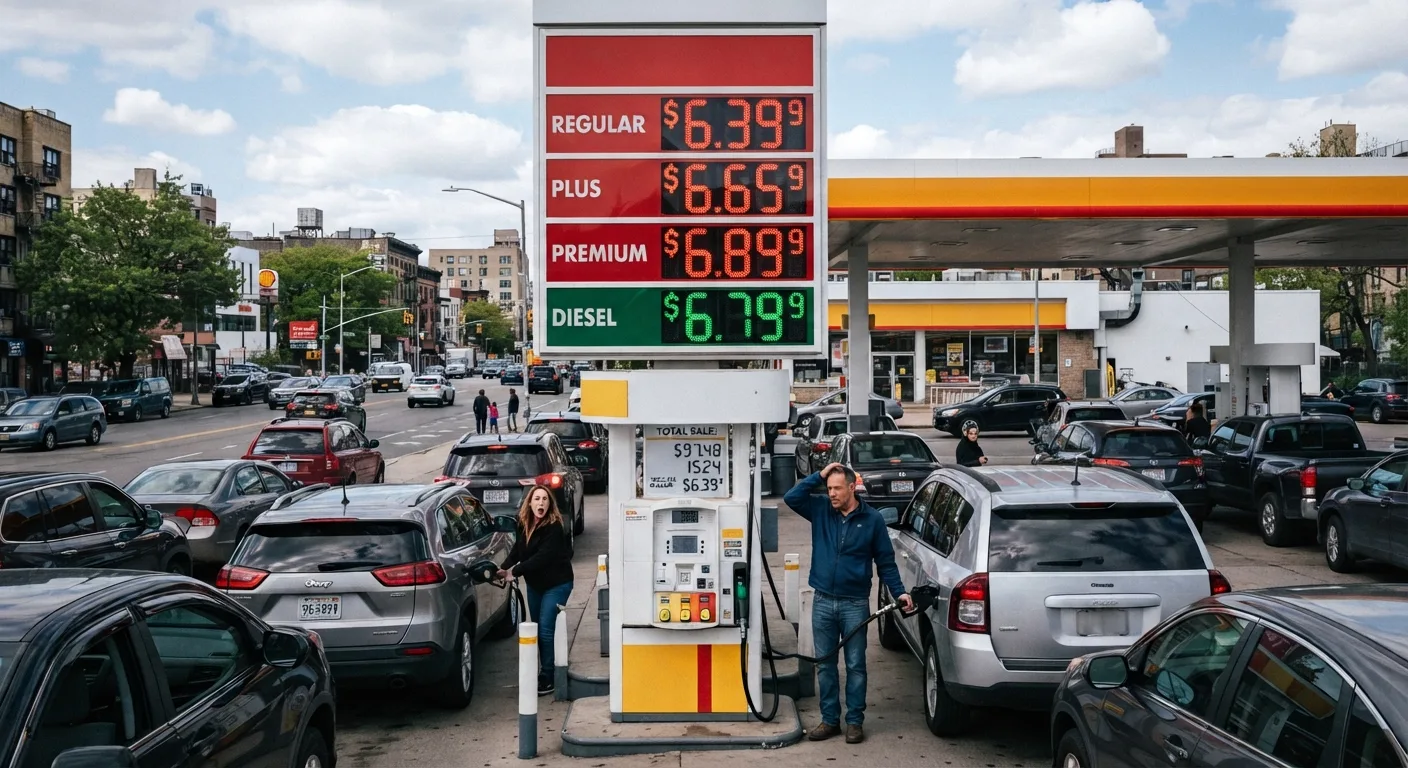
Gas hasn't hit its 2022 record ($5.01 a gallon), but it's up roughly a dollar from a year ago and climbing. Diesel — the fuel that actually moves freight — has gone further, setting a fresh record this September. Prices vary enormously by state: California ($5.87), Washington ($5.51), and Hawaii ($5.39) sit at the top; Indiana ($3.42), Texas ($3.67), and Oklahoma ($3.71) at the bottom, mostly reflecting state gas taxes and refinery proximity rather than the war itself.
The Iran war, briefly
On February 28, 2026, the U.S. and Israel launched a joint strike campaign against Iran, killing Supreme Leader Ali Khamenei among others and opening a war aimed at Iran's nuclear and missile programs. Iran retaliated with strikes on oil infrastructure across the region. A ceasefire held from April 8, and a U.S.-Iran framework for further talks followed in June — but that framework collapsed in August, and by September the conflict had settled into what's being described as a war of attrition. Through it, Iran has restricted traffic through the Strait of Hormuz, which the International Energy Agency has called the largest oil supply disruption in the market's history. Brent crude, which averaged around $69 a barrel in 2025, spiked as high as the low $90s in early March, eased back toward $70 during the ceasefire, and climbed back to roughly $97–$100 in September as fighting resumed.
Other causes, at the same time
The war isn't operating alone. The U.S. refining system that turns crude into gasoline has shrunk by roughly 27% over the past three decades and is now running at 96–98% utilization — there's very little spare capacity to absorb a shock. More than half of U.S. refining capacity sits on the Gulf Coast, which is now entering the back half of hurricane season, a recurring seasonal risk independent of anything happening in the Middle East. Refiners were also mid-transition to summer-blend gasoline earlier in the year, which reliably pushes prices up every spring regardless of geopolitics.
The difference between the two (summer and winter blend) is a property called Reid Vapor Pressure (RVP) — essentially how easily the fuel evaporates. The EPA caps summer gasoline at a lower RVP (9.0 psi nationally, 7.8 psi in some smog-prone areas) than winter gasoline, because more volatile fuel evaporates faster in hot weather, and those vapors are a major ingredient in ground-level smog. Winter-blend gasoline is allowed a higher RVP because more volatile fuel vaporizes more easily in cold engines, which matters for starting a car in freezing weather but isn't a smog risk when it's cold out. Making the lower-RVP summer blend means refining out more of the cheap, highly volatile components (like butane) and replacing them with costlier ones, adding a real production cost — commonly estimated at up to 15 cents a gallon. Refiners have to have summer blend at retail stations by June 1 and can switch back to winter blend by mid-September, which is why prices typically dip 10–30 cents a gallon in late September and October in a normal year, war or no war.
Is the war the reason, or is fear doing some of the work?
Even among people who watch oil markets for a living, there's real disagreement about how much of the current price reflects oil actually being kept off the market versus traders pricing in fear of what might happen next.
It's a real supply shock
The IEA's "largest disruption in history" characterization reflects an actual, measured drop in oil moving through the Strait of Hormuz, not just sentiment — and Iran has directly struck oil infrastructure, not just threatened to. On this view, elevated prices track a genuine, ongoing loss of supply.
It's mostly a fear premium
Commodity strategist Carley Garner has argued oil would be trading in the $40s absent the conflict, pointing to a pattern going back to 2022: geopolitical scares repeatedly spike prices, very few barrels are actually removed from the market, and rallies eventually fade. On this view, current prices carry a large premium for what could happen, not just what already has.
The oil companies' quarter
- ExxonMobil, Q2 2026 profit
- $14.5B
- Chevron, Q2 2026 profit (a record)
- $12.1B
- Shell, Q2 2026 profit
- $9.8B
- Combined, per day, those three companies
- ~$404M
Company Q2 2026 earnings reports, via CNBC/CNN/NPR.
Exxon's profit more than doubled year-over-year; Chevron posted the largest single quarter in its history. Market reaction was mixed — Chevron's stock rose on beating estimates, while Exxon's dipped slightly on an earnings-per-share miss despite the record dollar total, a reminder that "record profit" and "beat Wall Street's expectations" aren't the same thing. Zoomed out further, the analyst firm Wood Mackenzie estimates the global oil and gas industry is on track for roughly $495 billion in 2026 profit above what it expected before the war began.
The windfall tax fight
Two Democratic bills would tax profits tied to the war specifically. Sen. Sheldon Whitehouse and Rep. Ro Khanna's proposal would levy a 50% tax on the gap between Brent's current price and 2025's $69 average — at July's $84 average, that's $7.50 a barrel. Rep. Brad Sherman's Iran War Oil Crisis Windfall Profits Tax Act goes further: a 100% tax on crude priced above $75 a barrel, set to expire automatically once prices fall back below that line. The American Petroleum Institute, the industry's main trade group, opposes both, arguing oil and gas is a cyclical business that should be judged over decades, not quarters, and that taxing profits "erodes the certainty needed to make investment" in the supply and infrastructure the country needs.
How it moves through everything else
Diesel is where higher fuel costs turn into higher prices for things that have nothing to do with driving. Fuel is roughly 21% of the cost per mile of running a truck, and trucking costs are up more than 14% year-over-year by producer-price data. Freight contracts typically separate a base shipping rate from a fuel surcharge that rises and falls with diesel prices specifically — so a diesel spike shows up in shipping invoices almost immediately, then in producer prices, and with a lag, in the price of groceries and other goods that traveled by truck to get to a shelf. Producer prices were already running about 6% higher than a year earlier as of the most recent reading with this dynamic visible in the data.
Nonpartisan, plainly
We don't take a position on the war itself, on whether a windfall tax is good policy, or on how much of the current price is "real" supply loss versus fear — serious people who study oil markets for a living disagree with each other on that last one, honestly. These are the disclosed prices, profits, and proposals, plainly, with the timeline that connects them.
Talking points
These are the questions we think you should ask those who are running for office and will represent you. We don't give our opinion on the answer, but we DO think you should be talking about them.
- Should Congress pass a windfall profits tax on oil companies during a war-driven price spike, and where should that revenue go?
- Should the U.S. release Strategic Petroleum Reserve oil to blunt a war-driven price spike, even at the cost of a smaller reserve later?
- Should gas taxes be temporarily suspended during a documented price spike, or does that just delay the cost rather than reduce it?
Read more
- AAA Newsroom: Pump Prices Keep Climbing as Crude Oil Remains Highnewsroom.aaa.com
The national and state-by-state gas price figures above.
- EIA: What's in your gasoline? Understanding U.S. motor gasoline formulationseia.gov
The Reid Vapor Pressure and summer/winter blend explanation above.
- Al Jazeera: Oil prices surge as US-Iran strikes intensify in Strait of Hormuzaljazeera.com
Reporting on the Strait of Hormuz disruption and crude price moves.
- Wikipedia: Timeline of the 2026 Iran waren.wikipedia.org
A dated, sourced timeline of the conflict, cross-referenced against contemporary news coverage.
- CNBC: Exxon and Chevron profits surge on rising oil prices due to Iran warcnbc.com
The Q2 2026 earnings figures for Exxon and Chevron.
- NPR: Oil companies are making billions. Calls to tax their windfall are growingnpr.org
The windfall-tax debate, including API's response, covered below.
- Congress.gov: H.R.8803 — Iran War Oil Crisis Windfall Profits Tax Actcongress.gov
The actual bill text for Rep. Sherman's proposal.
- Marketplace: Rising trucking costs could mean even more inflation for consumersmarketplace.org
The diesel-to-freight-to-consumer-prices figures below.